

Living Dialogically
Dialogue in the sense of David Bohm can be used wherever people want to think together, understand different perspectives and explore complex questions. It is particularly valuable in situations where different experiences, opinions or interests meet and simple solutions are not sufficient.
Dialogical communication should ideally be used in everyday interactions in social environments, in education, in healthcare, in organisations, communities, in business and in professional contexts. It can support learning, cooperation, team development, leadership, organisational change and transformation processes. At the same time, it can create spaces in which people from different backgrounds encounter one another, exchange experiences and develop a deeper understanding of one another.
A particular strength of dialogue lies in bringing together different perspectives and forms of knowledge. Instead of focusing exclusively on achieving agreement, dialogical competencies enable participants to explore differences and discover new connections. This can give rise to creative thinking, new ideas and shared understanding.
Dialogue can also be helpful in dealing with conflicts, changes or uncertainty. By creating a respectful and inclusive space for listening and reflection, dialogue can support people in moving beyond entrenched positions and exploring new possibilities together as well as individually.
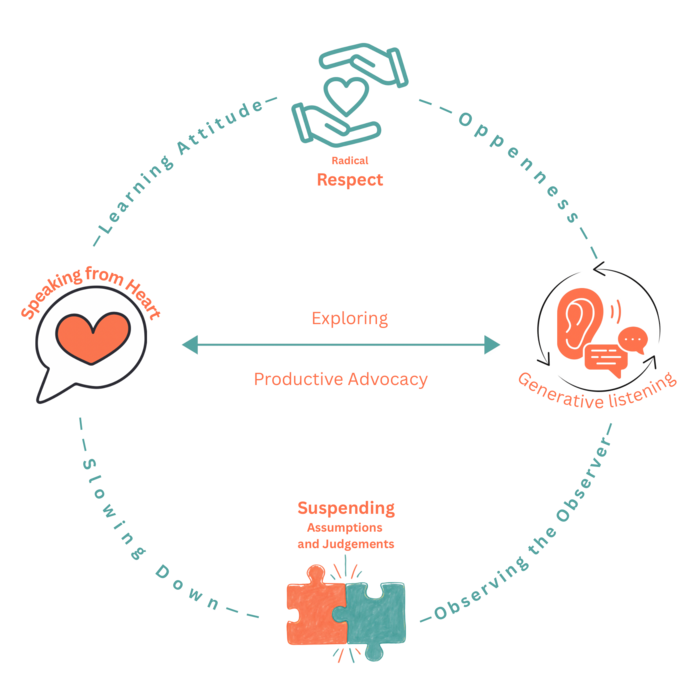
Dialogue is a form of working together that can be adapted to different contexts while preserving its fundamental principles: openness, respect, inclusion, listening and the joint exploration of thoughts and ideas.
The application of dialogue is therefore not limited to a particular field or a particular form, but is in every case a communicative, individual and shared process of practice.